You’ve perfected your menu. Your service is impeccable. Your location is prime. Yet, foot traffic remains inconsistent, and new customers aren’t finding you. What’s missing?
In Shanghai, the answer is often Dianping (大众点评) .
With over 310 million monthly active users and a staggering 7.7 billion cumulative reviews, Dianping—now integrated with Meituan—is the undisputed king of local discovery in China . It’s not just a review site like Yelp or TripAdvisor. It’s a full-fledged discovery engine, booking platform, and trust infrastructure all rolled into one.
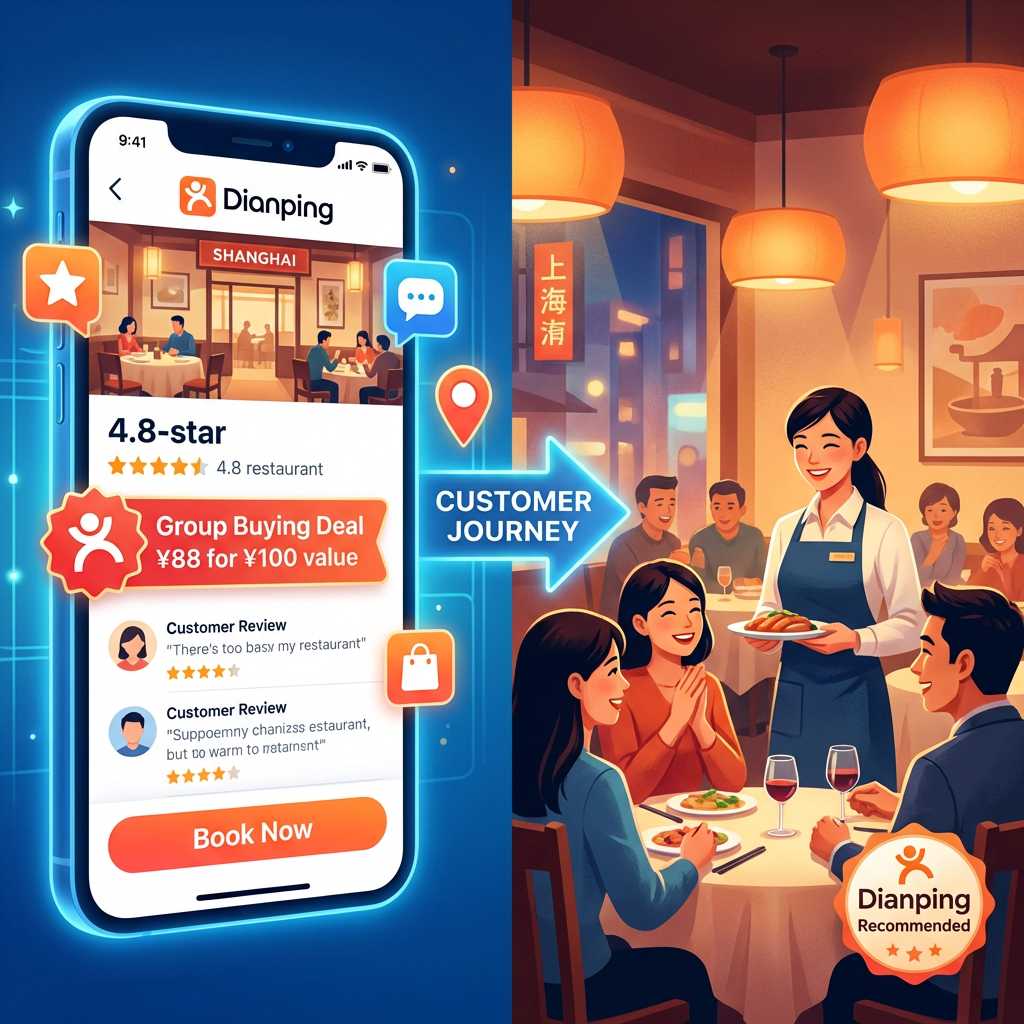
For Shanghai businesses—especially restaurants, retail stores, beauty salons, gyms, and service providers—mastering Dianping isn’t optional. It’s essential. This guide explains how the platform works and gives you a practical roadmap to improve your ranking, manage your reputation, and turn online reviews into offline revenue.
Part 1: What Is Dianping? (And Why It’s Not Just “Chinese Yelp”)
Dianping (大众点评) launched in 2003 as China’s first consumer review platform. In 2015, it merged with Meituan, China’s largest local services e-commerce platform . Today, they operate as an integrated ecosystem.
Think of the Meituan-Dianping ecosystem as two sides of the same coin:
| Platform | Primary Function | Western Equivalent |
|---|---|---|
| Dianping | Discovery & Trust (reviews, rankings, photos, recommendations) | Yelp, TripAdvisor, Google Maps Reviews |
| Meituan | Transaction & Fulfillment (food delivery, bookings, vouchers, tickets) | Uber Eats, Groupon, Expedia |
The key insight: Users discover on Dianping and transact on Meituan . A customer might read Dianping reviews to decide which hotpot restaurant to visit, then buy a discounted set meal voucher through Meituan and book a table—all without leaving the ecosystem.
This creates a powerful “Trust Loop” that compounds over time :
- Discovery & Decision: User searches Dianping, reads reviews, compares rankings
- Transaction & Fulfillment: User books or orders through Meituan
- Post-Purchase Feedback: User leaves a rating, photos, and comments
- Better Matching: Platform improves rankings and recommendations for the next user
In dense urban markets like Shanghai, the real scarcity isn’t supply—it’s confidence. Dianping closes that trust gap by turning customer experiences into a decision surface people can read, compare, and act on .
Part 2: How the Dianping Algorithm Actually Works
While Dianping doesn’t publicly disclose its exact algorithm, research and platform data reveal the key ranking factors .
The most important factors in 2026 are:
| Factor | Why It Matters |
|---|---|
| Review Recency | Fresh reviews (last 1-3 months) carry more weight. Users trust recent experiences. |
| Review Quality | Detailed reviews with photos and videos rank higher than single-sentence ratings. |
| Overall Rating | Average star rating (1-5) is the most visible signal to users. |
| Review Volume | More reviews = more social proof. Consistency matters more than spikes. |
| Response Rate | Businesses that actively respond to reviews (especially negative ones) signal engagement. |
| Completion Rate | How often users complete a transaction after viewing your listing. |
| Location Relevance | Proximity to the searching user (LBS – Location-Based Services). |
Platform incentives also drive review production :
- User motivation: Information gathering, emotional expression (venting or praising), and self-presentation (building a reputation as a trusted reviewer)
- Platform mechanics: Dianping’s tiered loyalty program (V1-V8) rewards frequent reviewers with status, privileges, and material incentives
- Merchant influence: Some businesses use “好评返现” (cashback for positive reviews), though this violates platform rules
For your business, the lesson is clear: actively managing your Dianping presence isn’t optional. It directly impacts how customers find and choose you.
Part 3: Why Your Shanghai Business Needs Dianping
Still not convinced? Here’s what you’re missing:
1. Massive Local Reach
Dianping and Meituan together serve over 510 million annual transacting users and cover more than 28 million global sites . In Shanghai, virtually every consumer uses it to discover restaurants, salons, gyms, and services.
2. High Purchase Intent
Unlike social media scrolling (where users are passive), Dianping users are actively searching for somewhere to eat, book, or visit. The intent to spend money is already there. Your listing just needs to convert that intent.
3. The Trust Imperative
Chinese consumers rely heavily on social proof before making decisions. A 2025 study found that users with high “skepticism” rely more on online reviews to reduce uncertainty. In other words, the more cautious your potential customer, the more they will check Dianping .
4. Competitive Necessity
If your competitors are on Dianping (and they are), and you’re not, you’re invisible to a massive segment of Shanghai consumers actively searching for services like yours.
5. Measurable ROI
Unlike traditional advertising, Dianping’s integrated ecosystem allows you to track the full customer journey: from discovery to review to transaction. You can see exactly what’s working.
Part 4: Actionable Strategies to Master Dianping
Now for the practical part. Here’s how to optimize your Dianping presence in 2026:
Strategy 1: Claim and Complete Your Listing
This is step zero. An unclaimed or incomplete listing signals neglect.
- Verify your business information (address, phone, hours, categories)
- Upload high-quality photos of your space, food, products, and team
- Ensure your location is accurate on the built-in map
- Add menu items, price ranges, and service descriptions
Strategy 2: Actively Manage Your Reviews
This is where most businesses fail—especially when it comes to negative reviews.
Key finding from a 2026 study: Restaurants that adopted automated review monitoring systems (ARMS) saw their average weekly Dianping rating rise by 0.358 stars on a 1-5 scale. Effects were even stronger for businesses with initially lower ratings .
Strategy 3: Encourage (Genuine) Positive Reviews
Never pay for fake reviews—Dianping’s algorithm detects them and penalizes violators. Instead:
- Train staff to politely ask satisfied customers to leave a review
- Make it easy: provide a QR code that links directly to your Dianping listing
- Offer a small, compliant incentive (e.g., entry into a prize draw, not cash for reviews)
Strategy 4: Use Promotions to Drive Traffic
Dianping and Meituan offer several promotional tools :
- Group Buying Deals (团购): Offer discounted set meals or service packages. This is a primary driver of new customer acquisition.
- Cash Vouchers (代金券): Let customers pay 85 RMB for a 100 RMB credit at your business.
- In-Feed Ads: Targeted advertisements within the Dianping and Meituan apps.
- Splash Ads: Full-screen ads when users open the app (high impact, higher cost).
For most SMEs, starting with group buying deals and cash vouchers offers the best ROI.
Strategy 5: Monitor Your Metrics
Use Dianping’s merchant backend to track:
- Your average rating over time
- Review volume and recency
- Where your traffic comes from (search vs. promotions)
- Your ranking for key search terms (e.g., “best coffee near Jing’an Temple”)
Strategy 6: Learn from Your Data
The businesses that succeed on Dianping don’t just collect reviews—they act on them. Use customer feedback to:
- Identify recurring complaints and fix operational issues
- Spot popular dishes or services and feature them
- Understand what customers value most about your business
Part 5: Common Mistakes to Avoid
| Mistake | Why It Hurts | Better Approach |
|---|---|---|
| Ignoring negative reviews | Signals you don’t care about customer feedback | Respond professionally and offer to resolve issues offline |
| Paying for fake reviews | Platform detects and penalizes violators; damages trust | Encourage genuine reviews from satisfied customers |
| Inconsistent information | Confuses customers and hurts local SEO | Keep address, hours, and contact info accurate across all platforms |
| No photo updates | Listings without recent photos look neglected | Add fresh photos weekly or monthly |
| Only responding to positive reviews | Negative reviews left unanswered damage reputation more | Respond to all reviews, especially negative ones |
Part 6: Advanced Tactics for 2026
1. AI Review Monitoring
Consider using automated review monitoring tools (ARMS). These systems :
- Monitor review platforms for new feedback
- Let an AI digest and categorize comments
- Create structured action items for staff (e.g., “check kitchen ventilation” or “retrain host on greeting”)
- Serve as a buffer before public responses, preventing emotional outbursts
2. Leverage Meituan Integration
Remember that Dianping and Meituan work together. Use Meituan’s advertising tools to drive traffic to your Dianping listing, and use Dianping’s reviews to build trust that converts Meituan users.
3. Seasonal Promotions
Dianping traffic spikes during holidays and peak seasons . Plan promotions around:
- Chinese New Year (late January/early February)
- Labor Day “Golden Week” (early May)
- Summer vacation (July-August)
- Mid-Autumn Festival (September/October)
- National Day “Golden Week” (early October)
4. Optimize for Mobile
Over 90% of Dianping users access the platform via mobile app. Ensure your listing looks good on small screens, loads quickly, and has clickable phone numbers and addresses.
Conclusion: Make Dianping Your Growth Engine
In Shanghai’s competitive local market, word-of-mouth has gone digital. Dianping is where trust is built, decisions are made, and customers are won or lost. A well-managed Dianping presence doesn’t just improve your rating—it drives foot traffic, increases revenue, and builds a loyal customer base.
But mastering the platform requires ongoing attention: responding to reviews, updating photos, monitoring metrics, and adjusting strategy based on data.
Need help mastering Dianping for your Shanghai business?
At Nimbadata, we help local businesses optimize their digital presence across China’s key platforms—from Dianping and Meituan to WeChat and beyond. We’ll audit your current listing, develop a review management strategy, and help you turn online reputation into offline results.
Contact Nimbadata today for a free Dianping audit. Let’s get your business found, trusted, and chosen.