Congratulations on deciding to enter the China market. Now, the real work begins. For foreign SMEs and startups, the most common mistake is rushing to build a website, only to hit a wall of technical, legal, and cultural barriers that delay your launch for months.
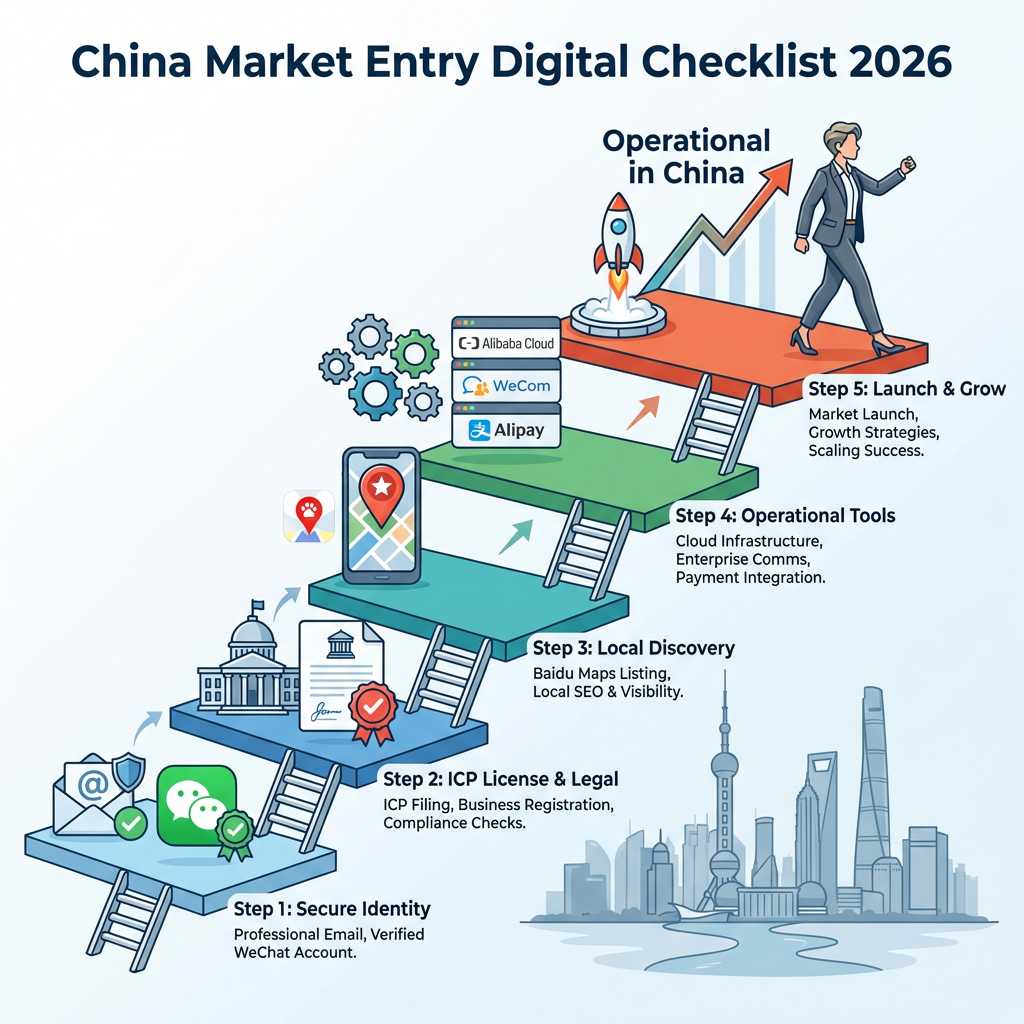
Success in China requires a different digital playbook. Your first day isn’t about design—it’s about laying a compliant, functional, and scalable foundation. This checklist is your action plan for the essential digital infrastructure you need to establish a credible, operational presence in Shanghai and beyond in 2026. Follow these steps in order to move faster and avoid costly missteps.
Step 1: Secure Your Professional Identity (Before Anything Else)
Before any marketing, you need the basic tools to operate and be contacted.
- Company Email Domain: Set up professional email addresses (
@yourcompany.comor@yourcompany.com.cn). Avoid using generic Gmail/Outlook accounts, as they harm credibility and can be unreliable. - WeChat Official Account Registration: This is your primary channel for B2C communication and many B2B interactions. Start the verification and registration process for a Service Account (服务号) or Subscription Account (订阅号) immediately. It can take 1-3 weeks and requires business documentation.
- Key Action: Have your legal entity documents (Business License, etc.) translated and digitized. You will need them for every step that follows.
Step 2: Establish Your Legal Online Presence (The Mandatory Gate)
You cannot have a website hosted in mainland China without government approval.
- Understand ICP Licensing: An ICP Beian (备案) is a mandatory filing with the MIIT (Ministry of Industry and Information Technology) for any website hosted on Chinese servers. It ties the site to your licensed Chinese legal entity.
- The Critical Path: DO NOT design or develop a full website yet. First, secure your domain name and initiate the ICP filing process through your future Chinese hosting provider (e.g., Alibaba Cloud, Tencent Cloud). This process is non-negotiable and can take 2-8 weeks.
- Pro-Tip: While waiting for ICP approval, you can create a simple, informative landing page hosted outside of China (e.g., on a global server) to start capturing interest and explaining your “coming soon” status.
Step 3: Build Your Local Discovery Footprint
Where will customers find you? In China, search and maps are dominated by local players.
- Baidu Business Listings: Claim and verify your business listing on Baidu Maps (百度地图). This is more important than Google Maps for local customer discovery.
- Local Service Platforms: Depending on your industry, list on Dianping (大众点评, for retail/F&B/services) or Zhihu (知乎, for B2B/consulting).
- Social Media Presence: Beyond WeChat, consider if Xiaohongshu (Little Red Book, for lifestyle/visual brands) or Douyin (for video content) are relevant for your initial audience.
Step 4: Set Up Your Operational Toolstack
The tools your international team uses daily likely won’t function optimally or at all.
- Communication: Adopt WeCom (企业微信, for internal team chat and external client communication), Feishu, or DingTalk instead of Slack or Microsoft Teams.
- Cloud & Collaboration: Use Alibaba Cloud or Tencent Cloud for file storage and sharing instead of Google Drive or Dropbox.
- Payments: Plan to integrate Alipay and WeChat Pay. Begin the merchant application process early.
Step 5: Plan Your Content & Marketing Foundation
With the infrastructure in place, you can now plan your message.
- Content Strategy: Decide on your language approach (Chinese-only vs. bilingual). Who will create and translate content? Quality translation is essential, not an afterthought.
- SEO Strategy from Day One: Plan your website structure and content with Baidu’s search algorithms in mind from the start. This is different from Google SEO.
- Performance Tracking: Set up Baidu Tongji (analytics) and ensure your team knows how to interpret the data.
Conclusion: Your Partner from Day One
Navigating this checklist alone is a full-time job that distracts from your core business. Each step has pitfalls—from ICP application rejections due to incorrect documents to choosing the wrong social platform for your audience.
This is where Nimbadata acts as your ground crew. We specialize in guiding foreign SMEs and startups through this exact process. We handle the technical and bureaucratic heavy lifting—from ICP filing and local hosting setup to integrating payment gateways and building your China-optimized website—so you can focus on your business strategy.
Don’t let digital complexity delay your China launch. Contact Nimbadata for a free China Market Entry Digital Audit. We’ll review your plan and provide a customized roadmap to get you operational, compliant, and competitive.