You’re a Shanghai SME owner. You know you need a digital presence. But where should you invest your limited budget? A traditional website? A WeChat Mini-Program? Both? The answer isn’t one-size-fits-all. In 2026, the choice depends on your business model, your customers’ behavior, and your growth goals.
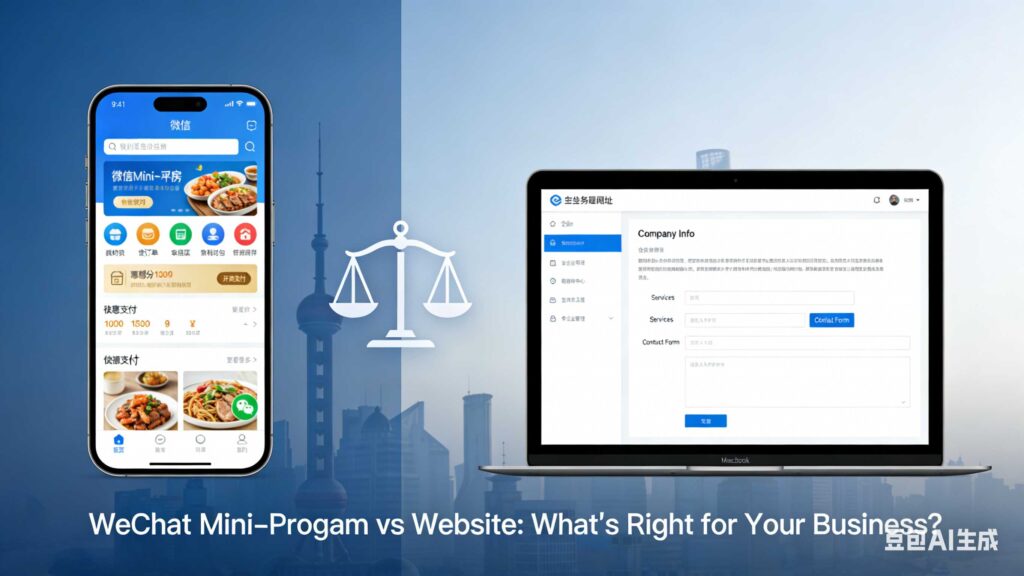
Let’s cut through the confusion. This guide breaks down the key differences, costs, and use cases for websites and Mini-Programs—so you can make the right decision for your business.
Part 1: What’s the Difference, Really?
| Feature | Traditional Website | WeChat Mini-Program |
|---|---|---|
| Access | Browser via URL (desktop + mobile) | Within WeChat app (scan or search) |
| Discovery | Baidu/Google search, direct links, ads | WeChat search, QR codes, sharing, Mini-Program marketplaces |
| User Experience | Full browser experience | Lightweight, app-like within WeChat |
| Development Cost | Moderate to high (responsive design, CMS, hosting) | Moderate (WeChat-specific framework, API integrations) |
| Maintenance | Ongoing (updates, security, hosting renewals) | Ongoing (WeChat API updates, feature iterations) |
| Data Ownership | Full ownership (your database, your server) | Shared with WeChat (user data accessible via APIs) |
| Key Strength | Credibility, SEO, full control | Seamless integration with WeChat ecosystem, high engagement |
Part 2: The Case for a Traditional Website
A website is still essential for many businesses. Here’s when it’s the right choice:
1. You Need Credibility and Control
For B2B companies, consultancies, and professional services, a professional website signals legitimacy. It’s your digital headquarters—a place where potential clients can learn about your expertise, see case studies, and contact you on their terms. You own the content, the design, and the data.
2. SEO Matters to Your Business
If customers find you through search engines (Baidu, Google), a website is non-negotiable. Mini-Programs have limited discoverability outside WeChat. A well-optimized website can rank for key terms like “Shanghai IT support” or “best accounting firm Jing’an” and attract organic traffic consistently.
3. You Need Complex Functionality
For e-commerce platforms, booking systems, or custom databases, a website offers more flexibility. You can build exactly what you need without the limitations of WeChat’s Mini-Program framework.
4. You Serve International Clients
If your customers are outside China, a website is essential. WeChat Mini-Programs are inaccessible to non-WeChat users and may be blocked outside China.
Best for: B2B services, consultancies, professional firms, international-facing businesses, complex e-commerce.
Part 3: The Case for a WeChat Mini-Program
Mini-Programs have exploded in popularity because they solve specific problems for China’s mobile-first, WeChat-centric users.
1. Your Customers Are Already on WeChat
For consumer-facing businesses—restaurants, retail, beauty salons, gyms—your customers live in WeChat. A Mini-Program meets them where they already spend time. No need to type a URL; just scan a QR code or search within WeChat.
2. You Want High Engagement and Sharing
Mini-Programs are built for the WeChat ecosystem. Users can share them directly in chats and Moments. A well-designed Mini-Program can go viral through social sharing in ways a website cannot.
3. You Need Fast, Frictionless Transactions
For ordering food, booking appointments, or purchasing services, Mini-Programs offer a seamless experience. Users can pay with WeChat Pay in seconds, without leaving the app.
4. You Want to Leverage WeChat’s Ecosystem
Mini-Programs integrate directly with WeChat Official Accounts (公众号), allowing you to push content and drive traffic. You can also use WeChat’s analytics and user behavior data to refine your offering.
Best for: F&B, retail, beauty, fitness, local services, events, and any business where customers are primarily Chinese consumers.
Part 4: The Hybrid Approach – When You Need Both
For many Shanghai SMEs, the answer isn’t either/or—it’s both. Here’s how a combined strategy works:
| Business Type | Website Purpose | Mini-Program Purpose |
|---|---|---|
| Restaurant | Show menu, location, brand story, SEO for “best Italian restaurant Shanghai” | Online ordering, reservations, loyalty program |
| Boutique Retail | Showcase collections, build brand authority | In-app purchases, flash sales, customer engagement |
| Consultancy | Display expertise, case studies, contact form | Quick consultation booking, client portal, event registration |
| Fitness Studio | Class schedules, instructor bios, location | Class booking, membership renewal, push notifications |
The key is integration: Your website and Mini-Program should work together. A customer might discover you via Baidu search, visit your website, then scan a QR code to book through your Mini-Program. Data should flow between both platforms through integrated CRM and analytics.
Part 5: Making Your Decision – A Simple Framework
Use this flow to decide where to start:
Step 1: Ask yourself these questions:
- Who is my primary customer? (Chinese consumer? International client? Business buyer?)
- How do they discover businesses like mine? (Search? Social sharing? Word of mouth?)
- What is the main action I want them to take? (Book? Buy? Contact? Read?)
Step 2: Match to the right tool:
| If you answered… | Start with… |
|---|---|
| Customer is Chinese consumer + action is purchase/book | Mini-Program |
| Customer is international or B2B + action is inquire/learn | Website |
| Both + you have budget for growth | Both (integrated) |
Step 3: Start simple, scale smart
Don’t overbuild. If you’re a new restaurant, a simple Mini-Program with online ordering might be enough. Once you have traction, invest in a website for brand building and SEO. If you’re a B2B consultancy, a professional website should come first. Add a Mini-Program later for client portals or event registration.
Part 6: The Cost Reality (2026 Estimates)
| Item | Website | Mini-Program |
|---|---|---|
| Design & Development | RMB 15,000 – 80,000 (depending on complexity) | RMB 10,000 – 50,000 |
| Annual Hosting | RMB 1,000 – 10,000 (China hosting + ICP license) | No hosting cost (WeChat platform) |
| Domain | RMB 50 – 100/year | Not required |
| Maintenance | 10-20% of dev cost/year | 10-20% of dev cost/year |
| WeChat Verification | Not applicable | RMB 300/year (for Official Account) |
| Payment Integration | RMB 0 – 5,000 (Alipay/WeChat Pay setup) | Usually included in Mini-Program development |
Note: Costs vary widely based on features, design quality, and developer rates.
Conclusion: Choose Based on Your Customer, Not on Hype
The question isn’t “which is better?” but “which is better for my business?” In 2026, Shanghai SMEs have powerful options. A website gives you credibility, SEO visibility, and full control. A WeChat Mini-Program gives you seamless access to China’s largest social ecosystem. And for many businesses, the real power lies in a thoughtful combination of both.
Not sure which path is right for you?
At Nimbadata, we help Shanghai SMEs make these strategic decisions every day. We’ll assess your business model, your customers, and your goals—then recommend a digital roadmap that delivers real results.
Contact Nimbadata for a free Digital Strategy Consultation. Let’s build the right foundation for your business in 2026.
Case Study: Shanghai Restaurant with WeChat Mini-Program
March 31, 2026[…] case study walks you through how we partnered with this Shanghai restaurant to build a WeChat Mini-Program that didn’t just digitize their operations—it transformed them. The result? Takeout orders […]