Welcome back to the Nimbadata blog! As we continue our journey through the Year of the Horse, it’s time to go deeper into one of China’s most powerful—and most misunderstood—platforms. In our last post, we explored diversifying beyond Baidu. Today, we’re dedicating an entire guide to the platform that deserves your closest attention: Xiaohongshu (小红书) , also known as Little Red Book or RedNote.
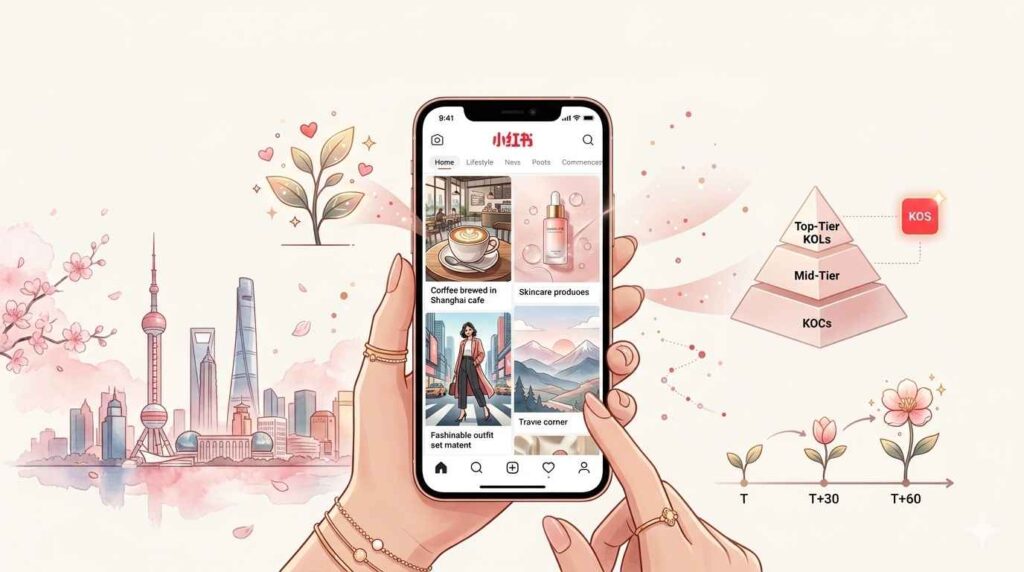
With over 300 million monthly active users and a valuation exceeding US$17 billion, Xiaohongshu has evolved into a distinctive social commerce hybrid—blending elements of Instagram, Pinterest, and Amazon . It has become the premier destination for China’s urban consumers, especially younger demographics, to discover, research, and purchase products through authentic peer recommendations.
But here’s what makes Xiaohongshu truly special: its users arrive with high purchase intent. They aren’t passively scrolling for entertainment; they are actively searching for “the best moisturizer for sensitive skin,” “Shanghai cafes with good vibes,” or “how to style a trench coat.” For Shanghai brands, mastering this platform is no longer optional—it’s essential. Let’s dive into how to win in 2026.
Part 1: Understanding the “Zhong Cao” (种草) Engine
The core behavior on Xiaohongshu is called “Zhong Cao” (种草) , which literally means “planting grass.” It’s the art of recommending or sharing a product or experience in a way that stimulates interest and desire in others . Users actively search for things related to their passions, and the platform’s decentralized algorithm rewards authentic, valuable content.
Unlike traditional marketing funnels that start broad and narrow down, Xiaohongshu promotes an “anti-funnel” model. You start by finding your core consumer and then expand outward to high-potential audiences . This means your strategy must begin with precision: identify the exact user who needs your product, speak directly to them, and let the algorithm do the rest.
Part 2: How the Xiaohongshu Algorithm Actually Works in 2026
To succeed on Xiaohongshu, you must understand its recommendation logic. The platform uses a CES (Content Engagement Score) system to determine which content enters larger traffic pools .
The CES Formula:
- Like: 1 point
- Favorite (Save): 1 point
- Comment: 4 points
- Share: 4 points
- Follow: 8 points
Notice the weighting: comments, shares, and follows are far more valuable than likes or saves . A post with a lively comment section where users debate, ask questions, and tag friends will outperform a post with many passive likes. This means your content must be designed to spark conversation.
2026 Algorithm Updates to Know:
- Quality & Originality Requirements: Xiaohongshu now requires posts to exceed 600 characters and maintain at least 60% originality. Enabling the “original content” declaration is strongly recommended .
- Vector Search Precision: The platform’s ability to match content with user intent has improved dramatically. Your title, content, and chosen hashtags must be perfectly aligned. Misusing trending topics that don’t relate to your content will actually reduce your reach .
Part 3: The New Content Playbook for 2026
The days of “saturation bombing”—flooding the platform with templated, low-quality posts—are over. As one industry expert puts it, “saturation attack thinking has failed; in 2026, the challenge is authenticity collapse” . Users have become sophisticated. They can spot inauthentic content instantly, and they will punish brands that insult their intelligence.
What Works Now:
- Use “Pain Point” and “Scenario” Language: Frame your content around real user needs. Think: “Oily skin morning routine,” “Small apartment organization hacks,” “Office-appropriate business casual.” These are searches real users type .
- Design for Comment Dominance: End your posts with questions, invite opinions, or share a controversial take that encourages discussion. A post with 50 thoughtful comments will outrank a post with 200 silent likes .
- Embrace Lifestyle Storytelling: Xiaohongshu users don’t want product manuals; they want to see your product embedded in an aspirational yet relatable lifestyle. Show, don’t just tell.
What to Avoid (The Brand Negative Assets):
- Templated Content: Avoid phrases like “OMG girls, this is amazing!” Users have developed “ad blindness” to these patterns .
- Saturation Bombing: When a user searches a topic and sees 10 nearly identical posts about the same product, the response is not “I should buy this”—it’s annoyance. One observer noted that a friend called this “not planting grass, but harassment” .
- Tacky Pain-Point Manipulation: Content that screams “Buy this or you’ll get wrinkles!” creates physiological aversion to your brand .
Part 4: The Creator Strategy Shift in 2026
The influencer hierarchy on Xiaohongshu has flipped. Research analyzing over 138,000 beauty posts revealed a counterintuitive finding: smaller creators and non-sponsored posts achieve higher engagement per impression and better cost-adjusted performance than top-tier creators and sponsored content .
The 2026 Creator Mix:
Pro-Tip: For mid-tier and KOC collaborations, avoid rigid briefs that turn content into a “product manual.” Give creators creative freedom to integrate your product naturally into their authentic content style.
Part 5: Measuring ROI in 2026 (It’s Not Just Direct Sales)
One of the biggest challenges on Xiaohongshu is measuring return on investment. Unlike e-commerce platforms, much of Xiaohongshu’s value lies in search influence and long-term brand building. Here’s how to approach measurement :
1. Track Search Keyword Growth:
Establish a core campaign keyword (e.g., “hydrating serum sensitive skin”). Monitor its search volume on Xiaohongshu and Taobao/Tmall before, during, and after your campaign. An increase in brand + product searches is a leading indicator of planting success .
2. Use the “T+X” ROI Mindset:
Xiaohongshu itself promotes an ROI (T+X) framework, where T is the posting date and X is the consumer decision cycle. For some products (like skincare), the decision cycle can be 20–60 days . A user may save your post today and purchase three weeks later. Measure over longer windows, not just the week of posting.
3. Consider Brand Lift Studies:
If budgets allow, use tools like Xiaohongshu’s Brand Lift surveys to measure changes in brand awareness, favorability, and purchase intent among users exposed to your content versus a control group.
4. Advanced Options (For Larger Budgets):
- 小红星 & 小红盟: These are joint projects between Xiaohongshu and Taobao/Tmall (小红星) or JD.com (小红盟) that enable closed-loop data tracking from planting to purchase . Note that these have minimum spend thresholds and are currently more suited to established brands.
Conclusion: Play the Long Game, Win on Xiaohongshu
Success on Xiaohongshu in 2026 is not about hacking the algorithm or flooding the zone with mediocre content. It’s about respecting the user, telling authentic stories, and building trust over time. Think of Xiaohongshu as a “savings bank for mindshare.” Every genuine, valuable post is a deposit. When a user finally enters the purchase decision window, they’ll withdraw from the brand with the largest balance of trust .
Ready to Build Your Xiaohongshu Strategy?
Navigating this complex platform requires local expertise, content creation capabilities, and a long-term perspective. At Nimbadata, we help Shanghai brands develop and execute Xiaohongshu strategies that drive real business results—from content planning and creator collaboration to performance tracking.
Contact Nimbadata today for a free Xiaohongshu strategy consultation. Let’s plant the seeds for your brand’s growth in 2026.