You’ve optimized your Baidu SEO. You’ve launched a WeChat Mini-Program. Your Dianping ratings are solid. Yet something still feels… off. Engagement is lower than expected. Conversion rates plateau. Your content doesn’t quite resonate.
The problem isn’t your tools. It’s your understanding of the person using them.
Chinese digital consumers are not just “different” – they are psychologically distinct. Their online behavior is shaped by a unique set of cultural, social, and technological forces that have evolved over decades. Understanding these forces is the difference between a campaign that performs and a campaign that truly connects.
This guide explores five psychological insights that explain why Chinese consumers behave the way they do online – and how you can use these insights to build stronger connections, drive engagement, and grow your business in 2026.
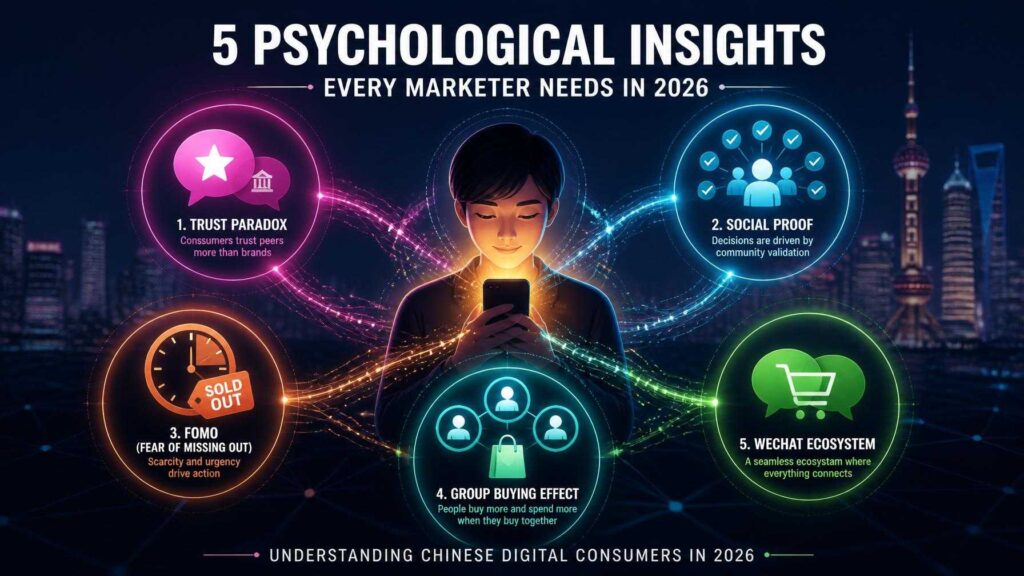
Insight #1: The Trust Paradox – Strangers Over Brands
The Observation:
Chinese consumers consistently rank “online reviews from strangers” as more trustworthy than official brand communications. A 2026 survey found that 83% of Chinese consumers trust user-generated content (UGC) more than brand advertisements – one of the highest rates globally.
The Psychology:
This isn’t irrational. It’s a learned response to decades of information asymmetry and occasional corporate misconduct. When brands have historically exaggerated claims, and regulators have struggled to keep pace, consumers learn to rely on each other.
This manifests as what researchers call “horizontal trust” – trust in peers and community members – over “vertical trust” – trust in institutions and authorities.
On Xiaohongshu (Little Red Book), this plays out daily. Users don’t search for “best moisturizer brand X.” They search for “dry skin morning routine” and read what dozens of ordinary users recommend. The brand is almost secondary to the collective wisdom of the crowd.
What This Means for Marketers:
| Don’t | Do |
|---|---|
| Lead with “We’re the best” claims | Lead with peer proof – user photos, real reviews, authentic testimonials |
| Polish everything to perfection | Embrace imperfection. Slightly messy user-generated content feels more real |
| Control the message | Facilitate the conversation. Create spaces where customers can share honestly |
| Hide negative feedback | Respond to it publicly and professionally. How you handle criticism builds more trust than praise |
Actionable Tactic: On your WeChat Official Account and Xiaohongshu, regularly repost customer photos and reviews – especially the unpolished, authentic ones. Tag the original poster. Make your customers the heroes of your content.
Insight #2: Social Proof as Decision Shortcut
The Observation:
Chinese consumers spend an average of 2.5 hours per day on social platforms – and much of that time is spent observing, comparing, and learning from peers before making purchase decisions.
The Psychology:
In high-choice, high-information environments, humans experience “decision paralysis.” When every category has hundreds of options, how do you choose? Social proof – “what are others like me doing?” – becomes the most efficient mental shortcut.
This is amplified in collectivist cultures where group harmony and social belonging are deeply valued. Choosing what “everyone else” chooses reduces social risk.
The Numbers:
- Products with 100+ reviews see 3x higher conversion rates than products with fewer than 10 reviews
- A 0.5-star increase in average rating correlates with a 25-30% lift in sales on major platforms
- “Most popular” and “bestseller” badges increase click-through rates by 40-60%
What This Means for Marketers:
| Don’t | Do |
|---|---|
| Launch with zero social proof | Seed your launch with trusted micro-influencers (KOCs) |
| Hide low review counts | Be transparent. Use scarcity and popularity signals honestly |
| Expect instant virality | Build social proof systematically over time |
| Ignore negative reviews | Use them as opportunities to demonstrate responsiveness |
Actionable Tactic: On your Dianping listing, actively manage your review volume. A restaurant with 500 reviews and 4.2 stars will often outperform one with 50 reviews and 4.8 stars – because the volume signals trust through scale.
Insight #3: Fear of Missing Out (FOMO) as Purchase Driver
The Observation:
Limited-time offers, flash sales, and “while supplies last” messaging generate conversion rates 2-3x higher in China than in Western markets.
The Psychology:
FOMO isn’t unique to China – but it’s amplified here. Several factors contribute:
- Platform Design: Chinese e-commerce platforms (Taobao, JD, Pinduoduo) are engineered for urgency – countdown timers, low-stock warnings, flash deals
- Social Pressure: When friends share a deal in a WeChat group, the social cost of missing out feels higher
- Economic Mobility: In a fast-changing economy, the fear of missing a good opportunity – even a small discount – is real
Singles’ Day (11.11) is the ultimate expression of this psychology. The 24-hour window, the countdown, the team leaderboards – every element is designed to trigger FOMO and drive impulse purchases.
What This Means for Marketers:
| Don’t | Do |
|---|---|
| Create fake urgency (users can tell) | Use genuine scarcity – limited inventory, seasonal products, exclusive drops |
| Overuse FOMO tactics | Save them for real promotions. If everything is urgent, nothing is |
| Ignore the post-purchase experience | The letdown after an impulse buy is real. Deliver quickly to maintain trust |
Actionable Tactic: For your WeChat Mini-Program or Dianping promotions, use genuine limited-time offers tied to real constraints (e.g., “First 50 orders get free delivery”). Track redemption rates to ensure you’re not accidentally teaching customers to ignore your urgency signals.
Insight #4: The Group Buying Effect – Social Commerce as Trust Multiplier
The Observation:
Pinduoduo, the e-commerce platform built entirely around group buying, grew from zero to over 900 million annual active users in less than a decade. WeChat group buying – where neighbors pool orders for bulk discounts – is a multi-billion yuan phenomenon.
The Psychology:
Group buying works because it transforms a solitary transaction into a social activity.
- Risk Reduction: If I buy alone and it’s bad, I feel foolish. If six friends buy together and it’s bad, we were collectively misled. The blame is shared.
- Social Bonding: Sharing a good deal feels like doing a favor. It strengthens relationships.
- Discovery Through Trusted Networks: I might ignore an ad, but if my friend shares a deal, I pay attention.
The platform mechanics reinforce this: Team leaderboards, chat functions within deals, and share-to-unlock features all leverage social psychology to drive transactions.
What This Means for Marketers:
| Don’t | Do |
|---|---|
| Treat group buying as just another discount channel | Design shareable, social experiences around your offers |
| Make sharing frictionful | Reduce clicks to share. One-tap to WeChat groups is ideal |
| Ignore the group leader | The person who initiates the buy is your most valuable customer. Reward them |
Actionable Tactic: If you have a WeChat Mini-Program, test a “friends and family” group buy feature. Offer a 15% discount for groups of 3 or more. Track not just sales lift, but customer acquisition cost – group buys often bring in new customers at a fraction of normal ad spend.
Insight #5: Mobile-First, WeChat-Centric – The Ecosystem Lock-In
The Observation:
Chinese consumers spend an average of 6+ hours per day on mobile devices – and over 2 hours of that inside WeChat alone. The app is not a platform; it’s an operating system for daily life.
The Psychology:
This isn’t just habit. It’s ecosystem lock-in. WeChat integrates messaging, payments, news, mini-programs, customer service, and social networking into a single interface. Leaving the app requires conscious effort and offers diminishing returns – because everything and everyone is already inside.
For consumers, the cost of switching attention is high. For brands, this means you must meet customers where they already are – inside WeChat.
What This Means for Marketers:
| Don’t | Do |
|---|---|
| Drive traffic to an external website | Build WeChat-native experiences (Mini-Programs, Official Accounts) |
| Expect users to remember a URL | Use QR codes and WeChat sharing as primary discovery mechanisms |
| Treat WeChat as just another channel | Treat it as your digital headquarters. Everything else feeds into it |
Actionable Tactic: Audit your customer journey. Where does it require users to leave WeChat? Every extra click outside the ecosystem is a drop-off point. Move as much of your funnel as possible into WeChat-native experiences.
Bringing It All Together: A Psychological Framework for 2026
These five insights aren’t isolated. They form a coherent framework for understanding Chinese digital consumers:
Trust is horizontal, not vertical. Peer recommendations outweigh brand claims. Invest in authentic UGC.
Social proof is the primary decision shortcut. Volume of reviews matters as much as star ratings.
FOMO drives action, but overuse breeds indifference. Use urgency genuinely and sparingly.
Group buying transforms transactions into social bonds. Design for sharing and collective benefit.
WeChat is the ecosystem anchor. Meet customers inside it, don’t pull them out.
When you combine these insights, successful campaigns share a common structure:
- Seed trust through authentic peer content (UGC, KOCs, real customer stories)
- Amplify social proof by making review volume and ratings highly visible
- Trigger action with genuine, limited-time urgency
- Enable sharing to turn one transaction into many
- Keep everything inside WeChat to minimize friction
Conclusion: Beyond the Tools, Understand the Person
You now have the technical toolkit – the SEO, the analytics, the platforms. But tools alone don’t build brands. Understanding the person using those tools does.
Chinese digital consumers are not mysterious. They are rational actors navigating a complex, fast-moving, high-choice environment. Their behavior – trusting strangers, following the crowd, responding to urgency, buying with friends, living inside WeChat – makes perfect sense once you understand their context.
In 2026, the brands that win will be those that design for psychology, not just for platforms.
Need help applying these insights to your Shanghai business?
At Nimbadata, we don’t just build websites and set up analytics. We help you understand your customers – what drives them, what they trust, how they decide. From WeChat Mini-Program strategy to content that resonates, we bridge the gap between digital tools and human psychology.
Contact Nimbadata today for a free consumer psychology consultation. Let’s build a strategy that connects.