Your website launched a few years ago. It worked back then. But lately, something feels off. Bounce rates are creeping up. It doesn’t quite match your current branding. Your competitor’s site looks sharper, faster, more trustworthy. You keep wondering: do I need a whole new website, or can I just patch this one up?
It’s one of the most common questions we hear at Nimbadata — and the answer isn’t always “rebuild everything.” This guide gives you a clear framework to diagnose your website’s real problem, decide between a refresh and a full redesign, and understand what each option actually costs in 2026.
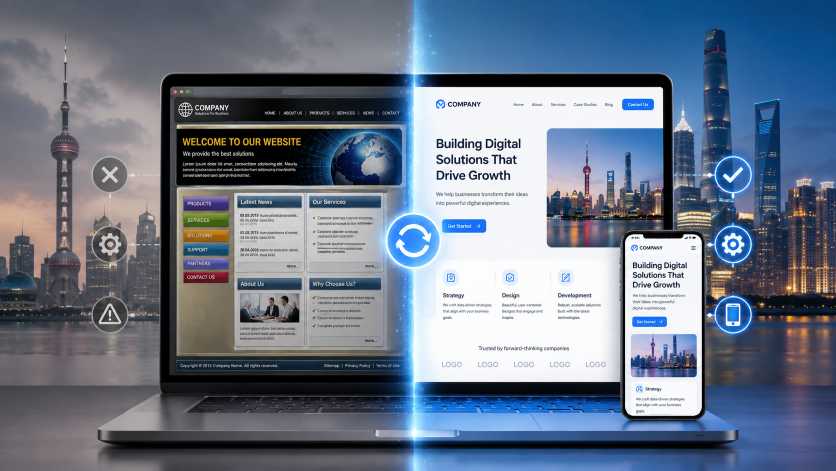
Part 1: Refresh vs. Redesign — What’s the Difference?
| Refresh | Redesign | |
|---|---|---|
| What changes | Visual updates, content, some UX tweaks | Structure, technology, full visual identity |
| Timeline | 1–3 weeks | 6–10 weeks |
| Cost (2026 est.) | RMB 5,000 – 20,000 | RMB 25,000 – 80,000+ |
| When it’s right | Site works, but looks dated or has minor UX issues | Site is fundamentally broken, outdated tech, or brand has evolved |
Part 2: 7 Signs It’s Time for a Redesign
- Your site isn’t mobile-responsive. Over 85% of Chinese web traffic is mobile. If your site doesn’t adapt cleanly to phone screens, you’re losing the majority of visitors before they even read a word.
- Your load time exceeds 3 seconds. (We covered this in depth in our post on slow websites — but if your site is both slow and structurally outdated, patching speed alone won’t fix the deeper problem.)
- You can’t update it yourself. If every content change requires calling a developer, your website is a liability, not an asset. Modern CMS platforms should let your team edit text, images, and even add pages without code.
- It doesn’t reflect your current brand. If your logo, colors, or messaging have evolved but your site hasn’t, you’re sending mixed signals to potential clients.
- It’s missing features your business now needs. Online booking, a bilingual toggle, an integrated blog, a client portal, e-commerce — if you’ve grown into needs your original site wasn’t built for, a refresh won’t add the structural capacity you need.
- It’s not built for China. No ICP license, hosted abroad, uses blocked services (Google Fonts, YouTube embeds) — these are foundational problems requiring a rebuild, not a patch. (See our guide on making your site China-ready.)
- Your competitors’ sites feel more credible. If a potential client would choose a competitor purely based on “who looks more legitimate online,” your website is actively costing you business.
Part 3: The Decision Framework
Ask yourself these three questions:
Q1: Is the underlying technology sound?
If your site runs on an outdated platform, isn’t mobile-responsive, or can’t be edited without a developer — that’s a technology problem. No amount of new photos fixes it. → Redesign.
Q2: Does the site do everything your business needs today?
If you’ve added services, expanded to a second location, or need functionality (booking, e-commerce, multilingual support) that wasn’t in the original scope — → Redesign.
Q3: Is it just look and feel?
If the site works well, loads fast, is mobile-friendly, and is easy to update — but just looks a bit tired or doesn’t fully match your current branding — → Refresh.
Part 4: What a 2026 Redesign Actually Costs
| Component | Refresh | Full Redesign |
|---|---|---|
| Design & UX | RMB 3,000–8,000 | RMB 10,000–30,000 |
| Development | RMB 2,000–8,000 | RMB 15,000–40,000 |
| Content (bilingual) | RMB 2,000–5,000 | RMB 8,000–20,000 |
| CMS setup/training | Included | RMB 2,000–5,000 |
| Domain/hosting/ICP (if new) | N/A | RMB 1,000–5,000/yr |
| Typical Total | RMB 5,000–20,000 | RMB 25,000–80,000 |
Costs vary significantly based on number of pages, custom functionality (booking systems, e-commerce, client portals), and whether you need net-new content creation vs. adapting existing copy.
Part 5: How to Minimize Risk During a Redesign
- Keep your URL structure where possible. Changing URLs without proper redirects tanks your SEO rankings overnight.
- Migrate your content deliberately, not by copy-paste. This is a chance to improve, not just relocate, your messaging.
- Test on real devices before launch — especially WeChat’s in-app browser, which renders differently than Safari or Chrome.
- Keep the old site live during transition until the new one is fully tested and DNS has propagated.
Conclusion: Don’t Guess — Diagnose First
A website redesign is a meaningful investment, and getting the “refresh vs. rebuild” call right saves you both money and headaches. The goal isn’t to spend more — it’s to spend correctly, on the thing that’s actually broken.
Not sure which path is right for your site?
At Nimbadata, we start every redesign conversation with a free website audit — evaluating speed, mobile experience, ICP compliance, and structural fit for your business goals. We’ll tell you honestly whether you need a refresh or a full rebuild, and give you a clear cost estimate before you commit to anything.
Contact Nimbadata today for a free website audit. Let’s find out what your site actually needs.