Your Shanghai SME is growing. Your website traffic is increasing. You’re collecting more customer data. You’re considering building a WeChat Mini-Program or scaling your e-commerce operations. Suddenly, that basic shared hosting plan isn’t cutting it anymore.
It’s time to move to the cloud. But which one?
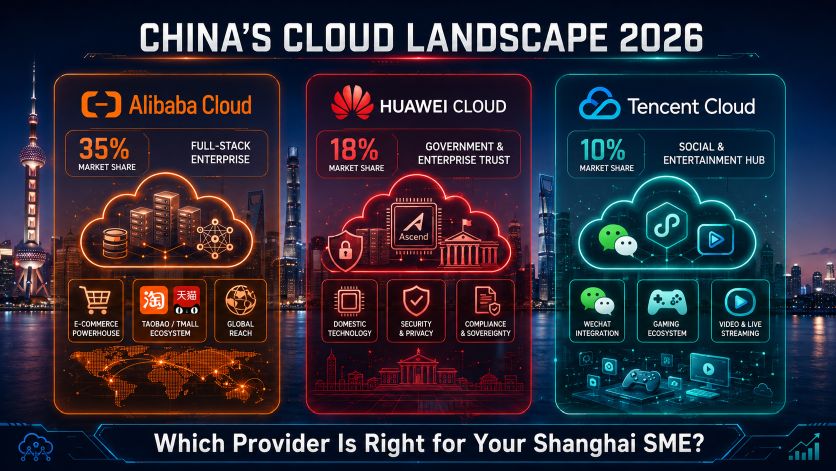
In China, the cloud landscape is dominated by three domestic giants: Alibaba Cloud, Tencent Cloud, and Huawei Cloud. Together, they control over 65% of the Chinese cloud market, with Alibaba leading at approximately 35%, followed by Huawei at 18%, and Tencent at 10% . And with the AI boom, China’s cloud market is projected to grow at an annual rate of 26.8% through 2030 .
But market share alone doesn’t tell you which provider is right for your business. This guide breaks down the key differences, pricing, strengths, and weaknesses of each platform—so you can make an informed decision.
Part 1: The Big Picture – China’s Cloud Market in 2026
Before diving into specifics, understand the macro context.
| Provider | China Market Share | Global Market Share | Key Strength |
|---|---|---|---|
| Alibaba Cloud | ~35% | ~4% | Full-stack ecosystem, largest service portfolio |
| Huawei Cloud | ~18% | N/A | Government/enterprise trust, sovereign tech |
| Tencent Cloud | ~10% | N/A | Social/entertainment ecosystem, WeChat integration |
| Others (incl. AWS China, Azure China) | ~37% | N/A | Specialized or niche offerings |
Sources: Omdia Q1 2025 China cloud data
What the numbers tell us:
- Alibaba Cloud is the 800-pound gorilla. It has the broadest service portfolio and deepest ecosystem .
- Huawei Cloud is the rising challenger. Its strength in government and enterprise sectors, combined with domestic chip production (Ascend), gives it a unique advantage .
- Tencent Cloud is the social play. Its deep integration with WeChat, gaming, and entertainment makes it the choice for customer-facing businesses.
Part 2: The Price Comparison – What Will It Actually Cost?
Pricing is often the first question. But it’s also the most complex. Cloud pricing isn’t just about the base compute cost—it includes storage, data transfer, and additional services.
2 vCPU, 4GB RAM General-Purpose Instance (On-Demand) :
| Provider | Instance Type | On-Demand (USD/hour) | 1-Year Reserved (USD/hour) |
|---|---|---|---|
| Alibaba Cloud | ecs.e-c1m2.large | $0.030 | $0.018 |
| Tencent Cloud | Standard S2 | $0.028 | $0.0168 |
| Huawei Cloud | S6.large.2 | $0.026 | $0.0156 |
Mid-2025 pricing, US East equivalent region
Key observations:
- All three Chinese providers are significantly cheaper than AWS ($0.0448/hour), Azure ($0.041), and GCP ($0.040) for comparable instances .
- Huawei Cloud offers the lowest on-demand price, driven by domestic chip production .
- Reserved instances (1-year commitment) can save you 40-45% across all providers.
Storage & Data Transfer Considerations:
| Provider | Standard Object Storage (per GB/month) | Outbound Data Transfer (first 10TB) |
|---|---|---|
| Alibaba Cloud | Competitive | Varies, often includes free quota |
| Tencent Cloud | Competitive | Varies, often includes free quota |
| Huawei Cloud | Competitive | Varies, often includes free quota |
⚠️ Hidden Cost Alert: Outbound data transfer (egress) can be a significant cost driver. Many SMEs underestimate how much they’ll pay to move data out of the cloud. Each provider offers a free tier for egress (typically 10-100GB/month), but beyond that, costs add up quickly.
Free Tiers :
All three providers offer generous free tiers for new users:
- Alibaba Cloud: $99/year promotional pricing for basic instances
- Tencent Cloud: Promotional pricing as low as $9/year for low-end instances
- Huawei Cloud: Aggressive promotional pricing for new customers
Part 3: The Ecosystem Advantage – Integration Matters
For many Shanghai SMEs, the decision isn’t just about price—it’s about ecosystem fit.
Alibaba Cloud: The E-Commerce & Enterprise Powerhouse
Best for: E-commerce businesses, enterprises needing a full-stack solution, companies with international operations.
Tencent Cloud: The Social & Entertainment Ecosystem
| Strength | Why It Matters |
|---|---|
| WeChat Integration | Native integration with WeChat Mini-Programs and WeCom |
| Gaming & Media | Optimized for gaming, livestreaming, and video content |
| Social Apps | Powering Douyin-like experiences with robust CDN |
Best for: WeChat-heavy businesses, gaming companies, media and entertainment, customer-facing apps.
Huawei Cloud: The Government & Enterprise Trust
Best for: Government contractors, enterprises with strict compliance needs, companies requiring domestic technology.
Part 4: Real Use Cases – Which Cloud for Which Business?
Use Case 1: E-Commerce Brand on Tmall
Recommendation: Alibaba Cloud
Why: Native integration with Alibaba’s e-commerce ecosystem. Data flows seamlessly between your store, analytics, and cloud infrastructure. You can leverage Alibaba’s AI tools for customer insights and personalization.
Use Case 2: WeChat Mini-Program-Only Business
Recommendation: Tencent Cloud
Why: Tencent Cloud offers the best integration with WeChat APIs, Mini-Program development tools, and WeChat Pay. Your customer data stays within the Tencent ecosystem, reducing latency and integration headaches.
Use Case 3: Data-Sensitive B2B Enterprise
Recommendation: Huawei Cloud
Why: If you handle sensitive data or work with government clients, Huawei’s sovereign technology stack and strong compliance credentials provide the trust and security you need.
Use Case 4: Multi-Cloud Strategy for Resilience
Recommendation: Alibaba + Tencent (or Alibaba + Huawei)
Why: Some SMEs choose two providers to avoid vendor lock-in and ensure redundancy. A common pattern: Alibaba for core infrastructure, Tencent for WeChat-facing services.
Part 5: Decision Framework – Choosing Your Provider
Use this framework to evaluate your specific needs:
| Factor | Questions to Ask | Weight |
|---|---|---|
| Ecosystem Fit | Do you use Alibaba/Taobao, WeChat/Tencent, or government-related services? | High |
| Price | What is your total expected spend? How sensitive are you to egress costs? | Medium |
| Performance | Do you need low-latency connections to specific regions in China? | Medium |
| AI Needs | Do you need advanced AI/ML capabilities or just basic compute? | Low-Medium |
| Compliance | Do you handle sensitive data or work with government entities? | High |
| Scale | How fast are you growing? Will you need additional services soon? | Medium |
Conclusion: Choose Based on Your Business, Not Just the Headlines
Alibaba Cloud is the market leader for good reason. Tencent Cloud excels if your business lives in WeChat. Huawei Cloud is the trusted choice for government and enterprise. But the “best” provider is the one that aligns with your specific business model, ecosystem, and growth plans.
Still not sure which cloud is right for you?
At Nimbadata, we help Shanghai SMEs navigate these decisions every day. We assess your technical needs, business context, and budget—then recommend, set up, and manage the right cloud infrastructure for your business.
Contact Nimbadata today for a free cloud readiness assessment. Let’s find the right foundation for your digital future.