Every SME starts the same way: bootstrapped, cost-conscious, using every free tool available. Free website builder. Free CRM tier. Free file storage. Free everything. It makes sense — why pay for what you don’t yet need?
But here’s what nobody tells you upfront: free software has a price. It’s just paid later, and usually in a currency more expensive than money — your time, your data, and your growth.
This isn’t an argument to abandon free tools altogether. It’s a framework for recognizing when “free” has quietly started costing you more than a paid plan would.
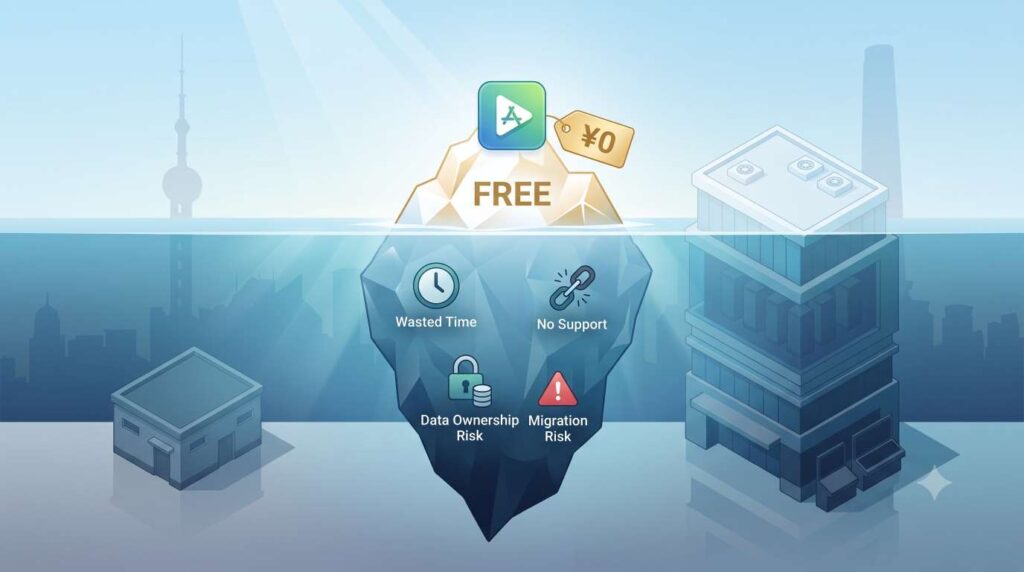
Part 1: The Five Hidden Costs of Freemium Tools
1. The Feature Wall Tax
Free tiers are deliberately designed to hit a wall right as your business starts needing more. You don’t discover the limit gradually — you hit it abruptly, usually during a busy period, and are forced into an urgent, unplanned upgrade decision instead of a considered one.
2. The Workaround Tax
When a free tool lacks a feature, teams don’t stop — they build workarounds. A CRM without automation becomes a spreadsheet with manual copy-paste. A website builder without a real CMS becomes “email the developer every time we need a text change.” These workarounds feel free but consume real hours every single week — hours that compound over months into a substantial hidden cost.
3. The Support Void
When something breaks on a free plan, there’s often no one to call. You’re searching forums, waiting on community support, or simply stuck. For a business-critical tool — your website going down, your CRM losing data — the cost of downtime while you troubleshoot alone can dwarf what a support-included paid plan would have cost.
4. The Data Ownership Risk
Many free tools reserve broad rights to your data, offer no real export options, or store customer information in ways that don’t meet basic data protection standards — a real concern under China’s PIPL and CSL requirements (see our 2026 Data Laws guide). If the free service shuts down, gets acquired, or changes its terms, your data — and your customers’ data — may not be recoverable the way you assumed.
5. The Migration Cliff
This is the biggest hidden cost of all. The longer you stay on a free tool that’s no longer fitting your needs, the more data, workflows, and team habits get built around it. Eventually, migrating away becomes a major project — costing far more in time and risk than if you’d upgraded (or chosen the right paid tool) earlier.
Part 2: A Framework for Evaluating “Is This Free Tool Still Free?”
Ask these four questions about any free tool your business currently relies on:
| Question | If “Yes” → Hidden cost is likely already active |
|---|---|
| Has your team built a manual workaround for a missing feature? | Workaround tax |
| Have you hit the same usage limit more than once? | Feature wall tax |
| Has something broken and you had no one to contact? | Support void |
| Would switching away today take more than a day of work? | Migration cliff |
If you answered “yes” to two or more, the tool has already stopped being free — you’re just not seeing the cost on an invoice.
Part 3: Common Categories Where This Bites Hardest
Website Builders: Free/cheap DIY builders often can’t support proper ICP-compliant local hosting, custom functionality, or genuine SEO — the workarounds compound until a full rebuild is the only path forward. (See our redesign guide.)
CRM Tools: Free CRM tiers cap contacts or users right as your pipeline starts growing — often right when good data discipline matters most.
File Storage & Collaboration: Free storage tiers fill up fast with client files, and personal accounts (rather than company-owned business accounts) create serious data ownership and continuity risk if an employee leaves.
Email & Communication: Free email hosting often lacks professional domains, proper security, and reliable delivery — undermining credibility with every message sent.
Part 4: When to Upgrade (and When Free Is Genuinely Fine)
Free tools are genuinely the right choice when:
- You’re testing a new process and don’t yet know if it’ll stick
- Usage is low and unlikely to hit limits soon
- The tool is non-critical to daily operations
It’s time to upgrade when:
- The tool touches customer data or revenue directly
- Your team has built more than one workaround for it
- You’ve hit a usage limit and growth shows no sign of slowing
- Downtime or data loss would meaningfully hurt the business
Part 5: How to Upgrade Without Overpaying
- Audit actual usage first. Don’t upgrade based on what you might need — upgrade based on documented friction you’re experiencing today.
- Calculate the real cost of staying free. Add up hours spent on workarounds per week × hourly value of that time. Compare honestly against the paid plan’s cost.
- Migrate data deliberately, not in a rush during a crisis. Plan the move before you’re forced into it.
- Choose tools that integrate, not just ones with more features. A paid tool that doesn’t talk to your other systems just moves the workaround problem elsewhere.
Conclusion: “Free” Is a Starting Point, Not a Strategy
Free tools are a legitimate way to start a business — they lower the barrier to getting moving. But treating “still free” as a permanent strategy, rather than a stage you deliberately graduate from, is where the hidden costs quietly accumulate.
Not sure if your free tools are costing you more than they save?
At Nimbadata, we help Shanghai SMEs audit their current toolset, calculate the real cost of workarounds, and plan upgrades that fit your actual growth stage — not oversized enterprise solutions you don’t need yet.
Contact Nimbadata for a free tool stack audit. Let’s find out what “free” is really costing you.